
Complex Adaptive Systems Theory
In today’s world of uncertainty, rapid change and increasing difficulty in making sense of ongoing developments, failures in decision-making are the rule rather than the exception.
In short, our world is complex:
- It is an open system.
- It operates under conditions that are far from equilibrium.
- It consists of large numbers of elements.
- There are direct and indirect loops of interactions.
- The elements interact dynamically. (Cilliers, P., 1998, Complexity and Postmodernism. Understanding Complex Systems, Routledge).
The Legacy of Santa Fe Institute
In order to understand complex systems, we need to look at whole systems, not just their parts. That is why scanning across disciplines and industries is a prerequisite for seeing emerging conditions. From different perspectives we notice different things. Novelty arises when different actors and disciplines collide, but also when the old and the new, order and chaos collide.
Despite its short history, the Santa Fe Institute has achieved impressive outcomes. (Waldrop, M. T., 1992,Complexity. The Emerging Science at the Edge of Order and Chaos, Open Road).
There is a clear logic of change at the Santa Fe Institute. It pursues emerging syntheses between mathematics and other scientific disciplines. It applies complexity science systematically, and often in cooperation with the Los Alamos Laboratory’s noted computational resources. As a result, new insights seem to have emerged organisationally as well as scientifically, at the boundaries, or interfaces, between people and organisations, ideas and technologies.
Professor Stuart Kauffman participated in the initial decade of the Santa Fe Institute. He looked back on those days:
”The emerging sciences of complexity grew out of earlier forays in systems theory, cybernetics, nonlinear dynamics, and chaos theory. It’s fair to say that the field crystallized out of its forerunners at the Santa Fe Institute in the mid 1980s. Among the topics we became excited about were Brian Arthur’s interest in increasing returns and path dependence in economics plus Per Bak’s discovery of self-organized criticality. Chris Langton, Norman Packard and my interest in the phase transition between an ordered regime and a chaotic regime, with the intriguing hypoth- esis that the most complex coordinated “computation” could take place in the ordered regime near the phase transition, dubbed the edge of chaos.” (Keskinen, A., Aaltonen, M. & Mitleton-Kelly, E. ,2003, Organisational Complexity. Foreword by Stuart Kauffman, FFRC Series).
“Edge of chaos” became a catchphrase. It embodied a deep meaning.

Our life is not a dichotomy between order and chaos. There is a different kind of order in between them – in complexity.
When we deal with living organisms – people, organisations and societies – we deal with complexity. Complex adaptive systems consist of a few key components:
- Complex systems involve a relatively large number of actors.
- The actors are intelligent and adaptive when they respond to new information and situations.
- No single actor has access to all the information or knows what all the other actors are doing. (Casti, J. L., 1997, Would-be-worlds, John Wiley & Sons).
Three Pivotal Papers
These are three pivotal papers for using complex adaptive systems theory in problem-solving.
- Aaltonen, M. (2007) Chronotope Space – Managing Time and the Properties of Strategic Landscape, Foresight, Vol. 9. No 4, 58–62.
- Mitleton-Kelly, E. (2015) Effective Policy Making: Addressing Apparently Intractable Problems, in Robert Geyer & Paul Cairney (eds.) Handbook on Complexity and Public Policy, pp. 111–128, Elgar.
- Snowden, D. & Boone, M. (2007) A Leader’s Framework for Decision-making, HBR, November, pp. 69 – 76.
An example often used by Paul Cilliers is “phone book is a complicated thing. It contains so many names and numbers, it is hard to remember them correctly. Making the mayonnaise instead is complex. We put the ingredients together, mix – and voilá something new emerges!”
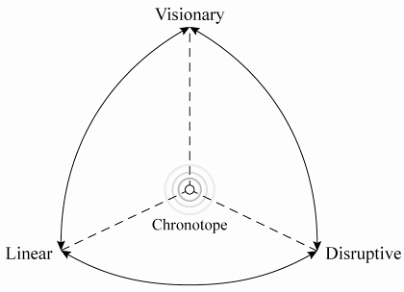
Chronotope, literally a place in time, is used in literature research to point out the specific context where the story comes into being. Here we use it to make sense of the strategic landscape, whether it is linear or disruptive, and time frames in question to elaborate appropriate responses.
Lessons from the History
The economist and moral philosopher Adam Smith is perhaps the first notable complexity thinker. His sound judgement was that markets and economies emerge, not hierarchically by diktat, but when actors make decisions according to their personal interest and act on limited, local knowledge. In short, the future emerges bottom-up, as a sum of numerous individual decisions. (Smith, A., 1776, The Wealth of Nations. An Inquiry into the Nature and Causes of the Wealth of Nations, Bantam Classics).
Moreover, the best place for a living organism – an individual, organisation or society – to survive is not in the ordered world, because there we cannot renew ourselves fast enough in respect to our changing environment. Nor is it in the chaotic world, because there we lose time and energy in figuring out our responses to the situation at hand.
Complex adaptive systems theory suggests two adaptation strategies.
If you are in the ordered world, you should look for ways to move yourself towards complexity, where new actors and ideas can enter your world. If you are in the chaotic world, you should present various ways to create more order and make more efficient action possible.
A phrase that has come out several times in our discussions is “interest in boundaries.” This idea is fascinating. It promises to deliver novelty, but we are not sure where the novelty comes from. We often think that a boundary is something that separates one thing from another, but the concept of a boundary becomes interesting when we start to think that, instead of separating things, it is an interface that brings people and things together.
The explicit consideration and development of our theory in use has practical consequences. It influences what things are considered worth noticing, what kinds of interpretations will be given to these things, and what kinds of actions will be taken. As John Maynard Keynes commented, policymakers are “practical men, who believe themselves exempt from any intellectual influence, but who generally are the slaves of some defunct economist.”
The Linux Story
Over 30 years ago, a Helsinki University student, Linus Torvalds, sent an email to fellow coders asking for their help. It became the kick-off for Linux, which is today one of the world’s most famous projects, with millions of lines of code.
Over the years, people and companies outside the US have become highly dependent on the American data giants. Nowadays, many of us believe that the only option to stay competitive and uphold a fair competitive environment is to embrace open data and open source artificial intelligence (AI) approaches. Many of us believe that these are the sole way for the smallest start-ups and small and medium-sized enterprises to benefit from collective learning and to leverage it to offer services at a lower cost.
Back then, Linux creator Linus Torvalds sent an email into the dark. He was simply asking for feedback from fellow developers. He did not know what kind of response, if any, he would get. He even noted that the new operating system he was developing was just a hobby, nothing big or professional. Interestingly, today we recognise Linux as one of the most professional software projects.
Here is the complete message, which is also the first Linux announcement from Linus Torvalds (www.fossbytes.com):
Hello everybody out there using minix –
I’m doing a (free) operating system (just a hobby, won’t be big and professional like gnu) for 386(486) AT clones. This has been brewing since april, and is starting to get ready. I’d like any feed- back on things people like/dislike in minix, as my OS resembles it somewhat (same physical layout of the file-system (due to practical reasons) among other things).
I have currently ported bash(1.08) and gcc(1.40), and things seem to work. This implies that I’ll get something practical within a few months, and I’d like to know what features most people would want. Any suggestions are welcome, but I won’t promise I’ll implement them 🙂
Linus (torv…@kruuna.helsinki.fi)
PS: Yes – it’s free of any minix code, and it has a multi-threaded fs. It is NOT protable (uses 386 task switching etc.), and it prob- ably never will support anything other than AT-harddisks, as that’s all I have 🙁
The outcome was not a result of design but of the interaction between the system and its environment and of the adaptation to indirect and direct feedback from the environment. The future was being formed and amplified as an ongoing process. The future was embedded in daily choices and decisions.
And, it will remain so, also for us.
One Research for the Future
Our distinguished white paper Arctic Strategy explained how three global disruptions – the melting down of the Arctic, the use of enormous energy reserves on the top of the planet and the transformation of the global transportation – slowly gather on the horizon. They come from different directions. Together they form a sophisticated fabric and weave the world trade in a new system of systems.
The follow-up white paper Brave New World discusses the strategic, economic and political consequences of a changed world. We have used complex adaptive systems theory as our basis for understanding the change, methods based on that plus traditional and foresight methods in our research.
Reviews:
“The esteemed author Mika Aaltonen draws upon cutting-edge research and real-world examples on this thrilling exploration of the future of transportation. Be prepared to be inspired, informed, and enlightened.”
Professor Jürgen Sorgenfrei, Former CEO, Port of Hamburg & Director, INER Institute, Northern Business School, Hamburg.
“With his unique blend of deep expertise and accessible writing style, Mika provides a compelling overview of the latest developments in transportation, from airfreight and hinterland rail to lines of maritime communication, geopolitics and ports. Whether you’re a transportation enthusiast, an industry professional, or simply curious about the world of mobility, this paper will inspire you to envision the possibilities of the Brave New World of transport.”
Kustaa Valtonen Partner, Finest Bay Area Development & Chairman, Smart City Innovation Cluster.
“Brave New World gives us not just insights about emerging futures for the world and ports in particular but as well frames the future through a rigorous analysis of history. It is packed with insights that help us reframe futures and create new strategies. Brilliant work by leading futurist Aaltonen.”
Sohail Inayatullah Professor, Tamkang University, UNESCO Chair in Futures Studies & Editor, the Journal of Futures Studies.
“A mindset without a method is an excuse,
a method without a theory is stupidity.”
Dave Snowden